
AstroPlotorium User Manual
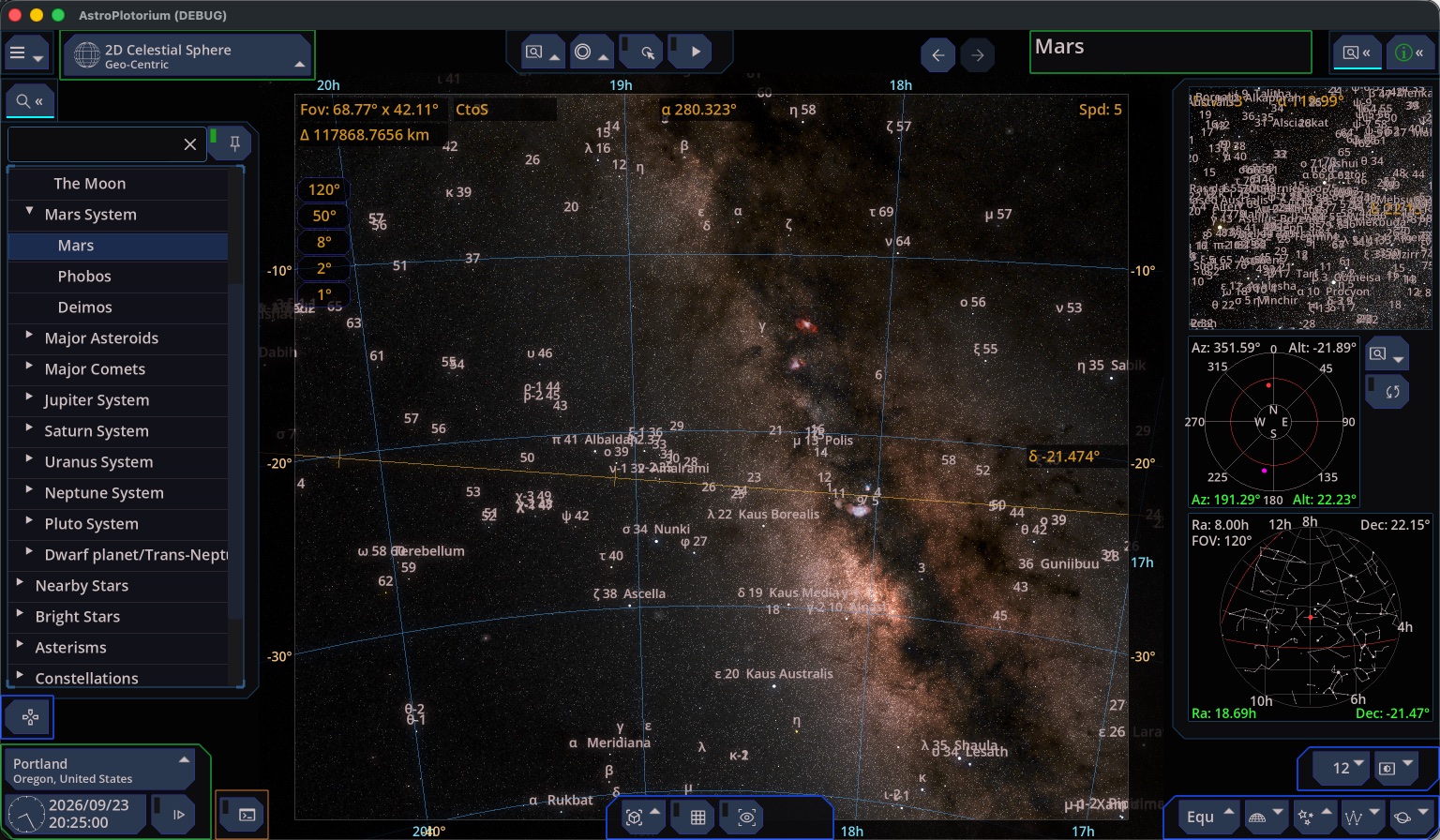
Stars
Stars come from the HYG catalog and, for the nearby-star lists, from a nearby-star catalog. A star’s color on screen follows its color index. Its dot size follows magnitude so bright stars read as bright. That size is a symbol. It is not the star’s angular diameter. The Sun is the only star large enough, in true angle, to show a disc in ordinary fields of view.
Names you can turn on separately:
- Common name.
- Bayer designation (Alpha Orionis, and the Greek letter).
- Flamsteed number.
- Hipparcos (HIP) number.
Bright Stars in the navigator are grouped by magnitude so you can tour the sky from the brightest downward. Nearby Stars add distance in light-years and the spectral type.
Selecting a star opens its property list: coordinates, magnitude, spectrum, and distance when the catalog has them. In the ephemeris view you also get a daily altitude table. A star’s rise and set change through the year only because of the Earth’s orbit and your latitude, not because the star is moving across the sky in a way you can see night to night. Proper motion is included in the catalog position. It is not something the eye tracks in this app.
Constellations and asterisms
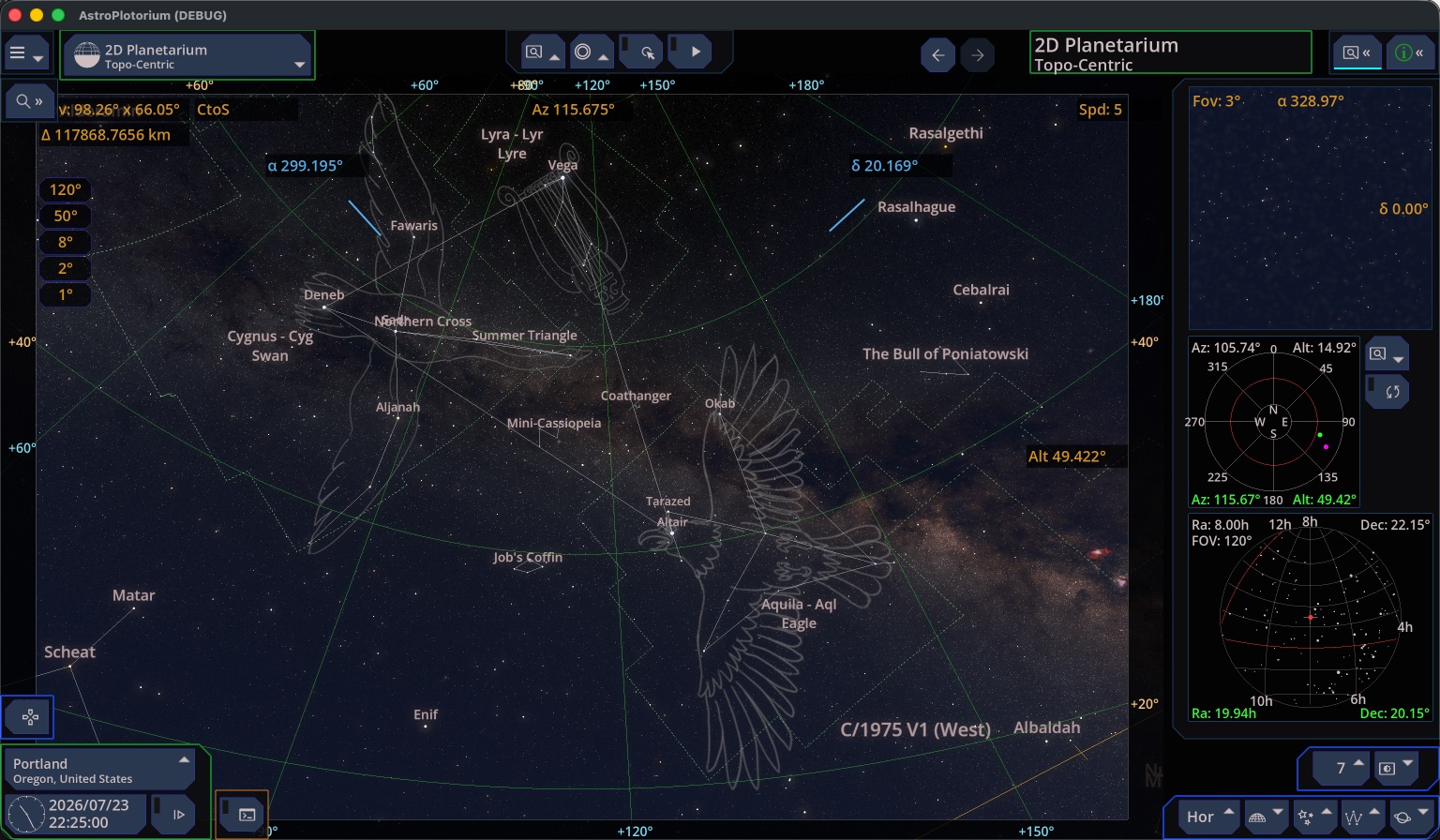 Cygnus, Aquila, Lyre, and the Summer Triangle.
A constellation row selects that region and aims the camera at it. The eye on the row shows or hides that figure alone. View All, Hide All, and Zodiac set many at once.
The figure has four drawings, each optional: the name, the stick-figure lines, the official boundary, and an artistic image. Asterisms (the Big Dipper, the Summer Triangle, and the rest) have a name and a line, and they are not the IAU constellations. A culture’s figures are a map drawn on top of the stars. Turning on boundaries shows that the IAU regions tile the whole sphere.
Deep sky
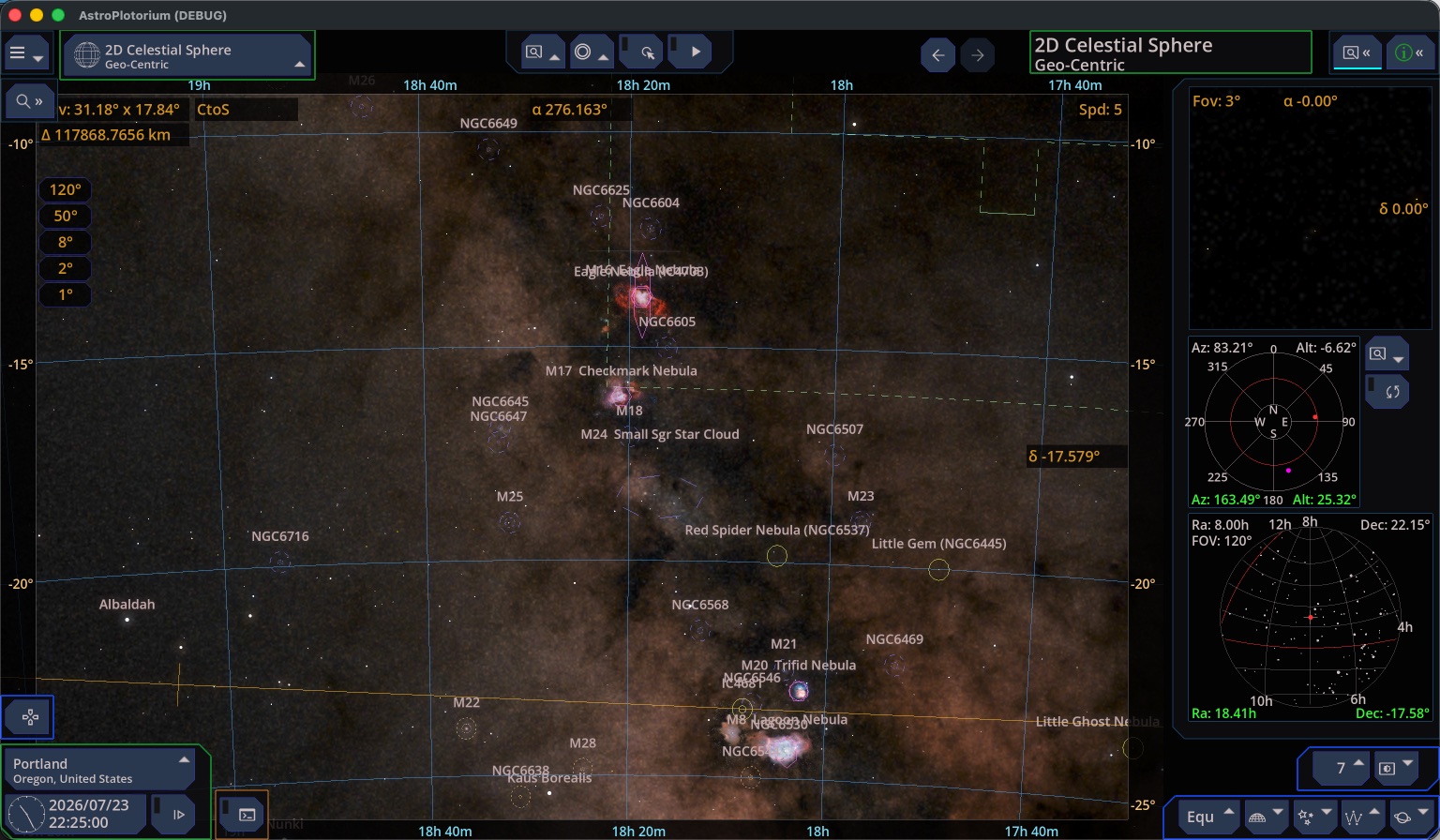
Three lists cover most browsing:
- Messier. The classic 110.
- Caldwell. The complementary list.
- Deep Space Objects. Named and brighter objects from the larger catalog, with a type in the row label.
Images draws a picture on the dome at the catalog position, scaled to the catalog angular size. The picture is a portrait placed on the sky. The coordinates and the size in the property panel are the catalog values.
In 3D Universe, some open clusters are also built as star clouds you can fly around. Those are listed under Open Clusters in 3D, not in the flat deep-sky list. The flat list is the sky position. The 3D cluster is a spatial model of the members.
Milky Way
The Milky Way can be a photograph, a field of dots, or both. The photograph is a sky texture. The dots are a density drawing. Neither is a 3D model of the galaxy. The 3D galaxy is the Milky Way Galaxy entry in 3D Universe.