AstroPlotorium User Manual
Simulation in the Main View menu opens a catalog of models. These scenes show the structure of a kind of object. They are not the Messier photograph of a named target, and they are not at a catalog right ascension. To see M31 in the sky, select it under Messier in a sky view.
These simulations are still in experimental, especially Nebulae. I’ll continue to improve them.
Galaxies
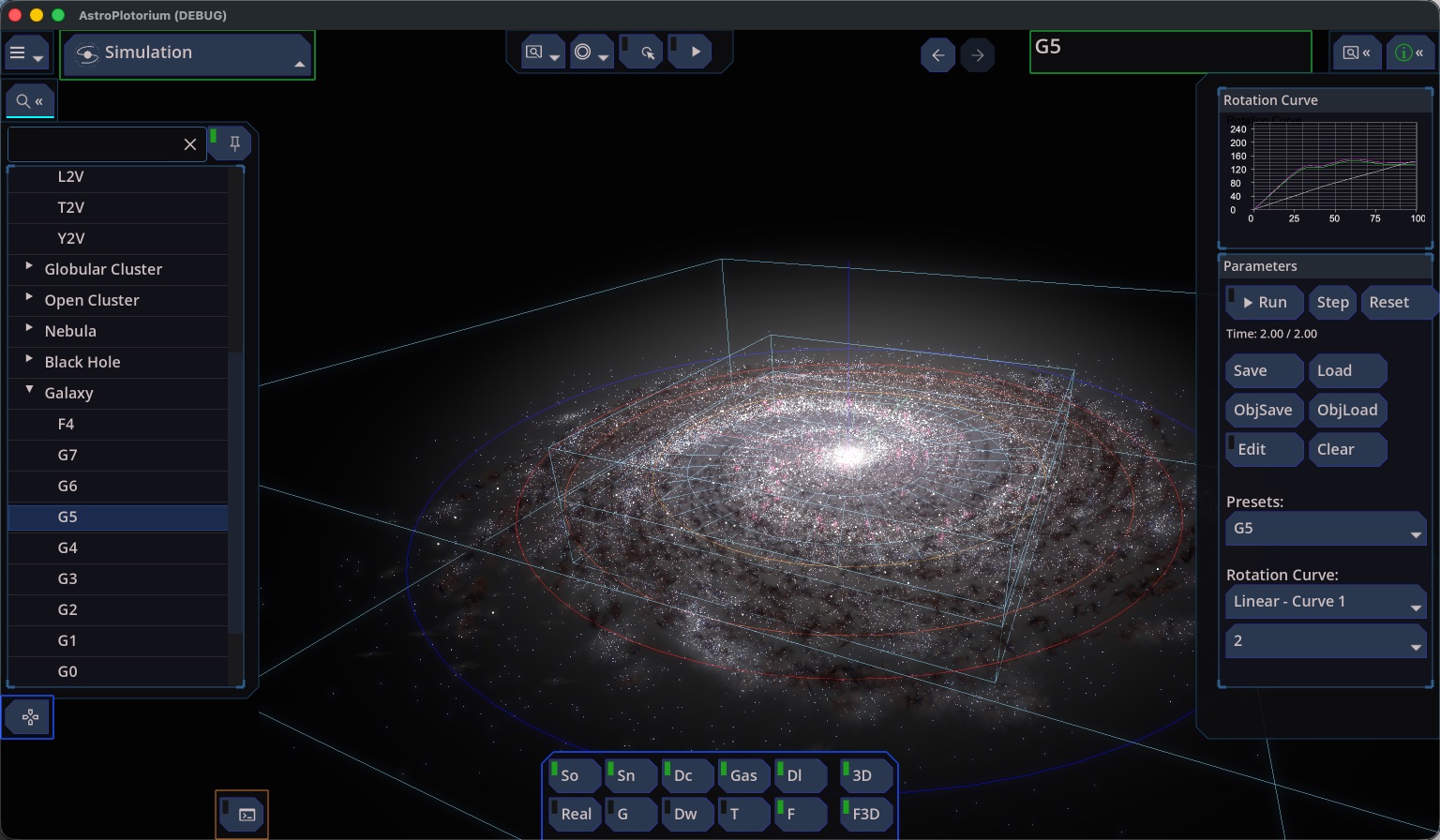
The list is a set of Hubble types: spirals and barred spirals (the S and SB sequence, shown as G and F entries), lenticular (L), and elliptical (E). Pick one to fill the view with that stellar model. You orbit it like any other 3D target.
A saved galaxy can be stored as a single zip that holds the simulation description and the star data. Loading prefers that zip. Older pairs of a JSON file plus a star file still open. This is how a custom galaxy model is kept. It is separate from the built-in type list.
Clusters
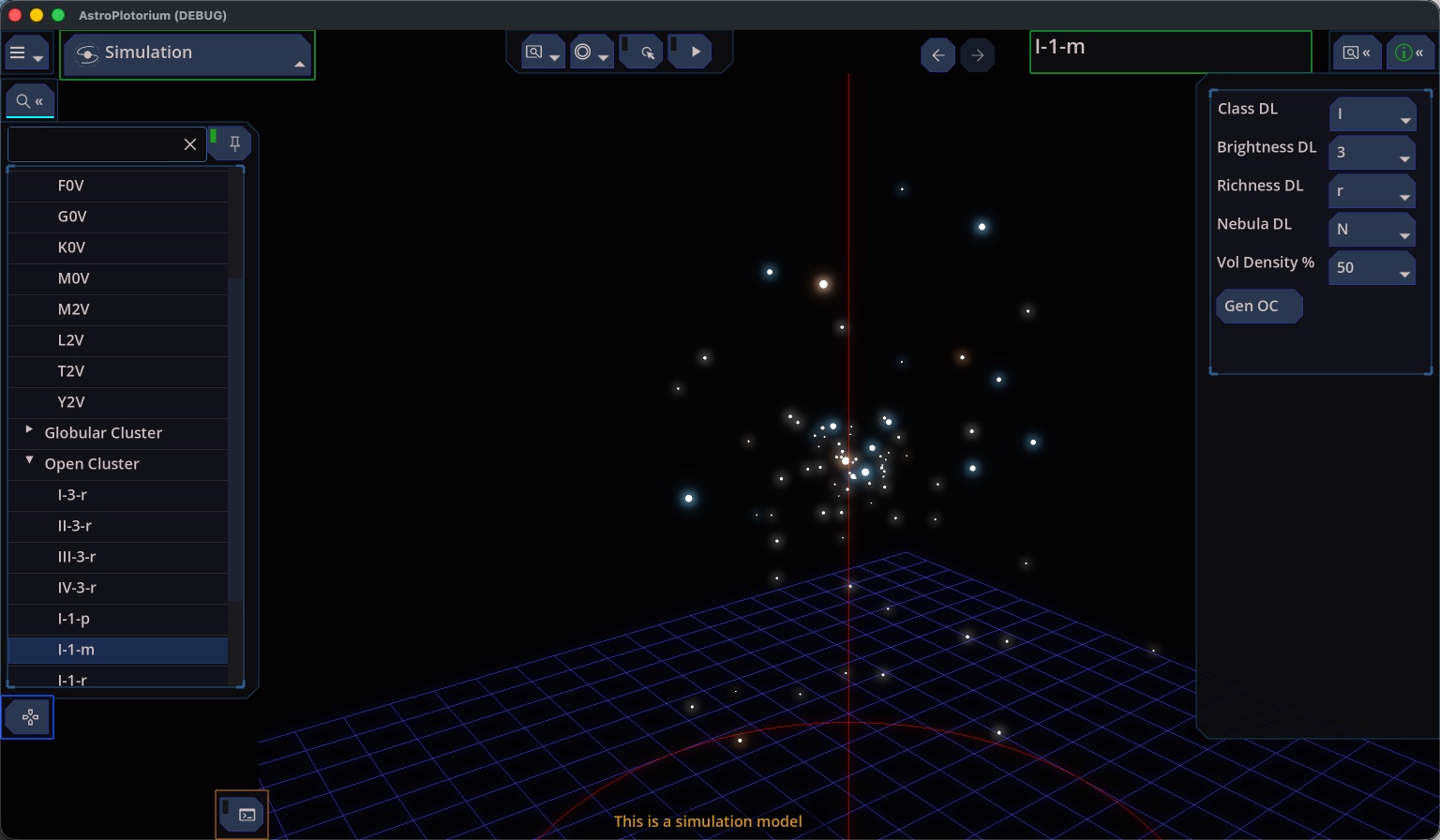
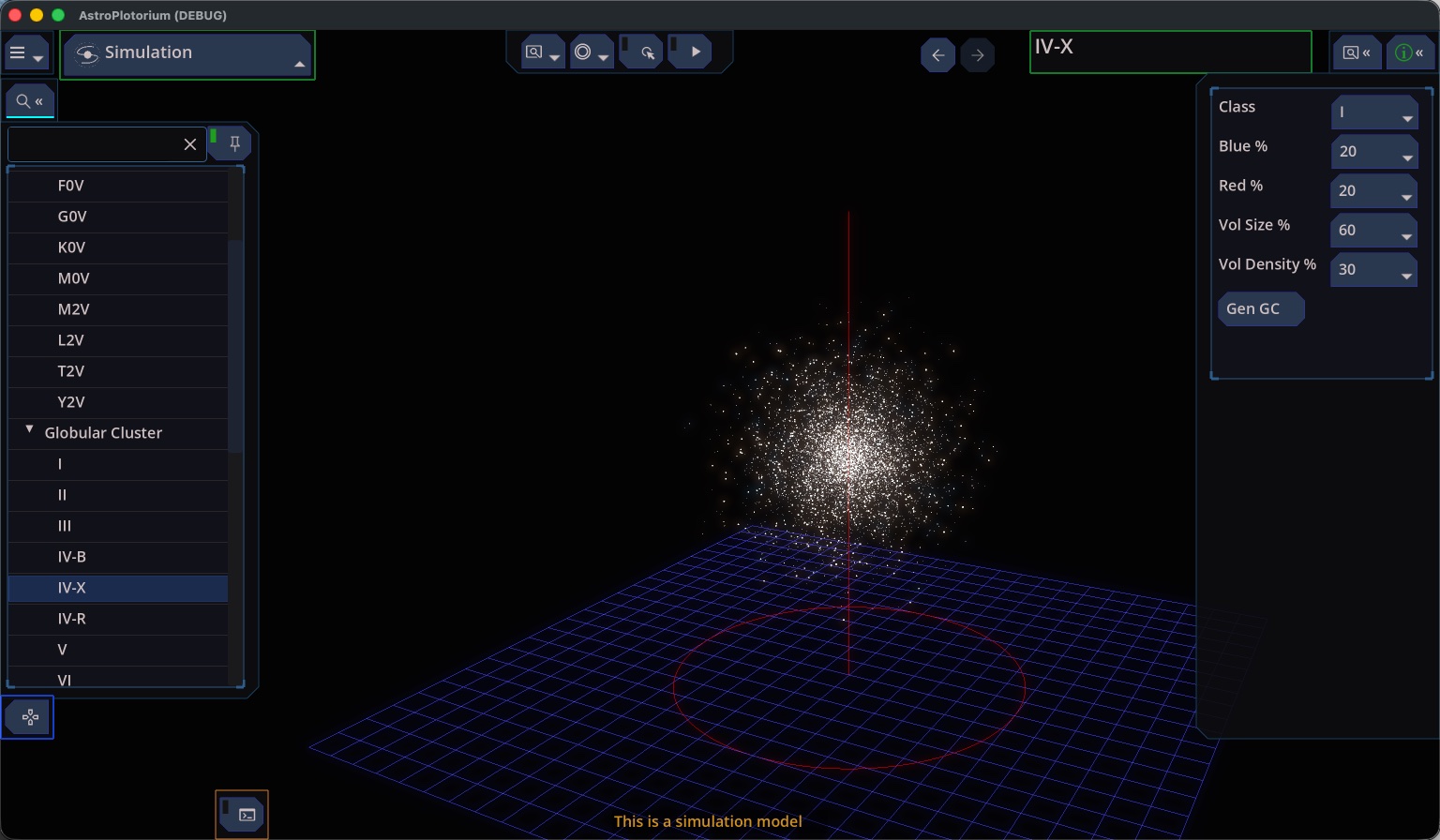
Globular-cluster entries follow concentration classes. Open-cluster entries follow a Trumpler-style label (concentration, brightness range, and richness, such as I-3-r). The point of the list is to compare structures: a tight globular against a loose open cluster, not to match one catalog cluster unless the label names it.
Named open clusters with member-star positions also appear in 3D Universe under Open Clusters in 3D.
Nebulae
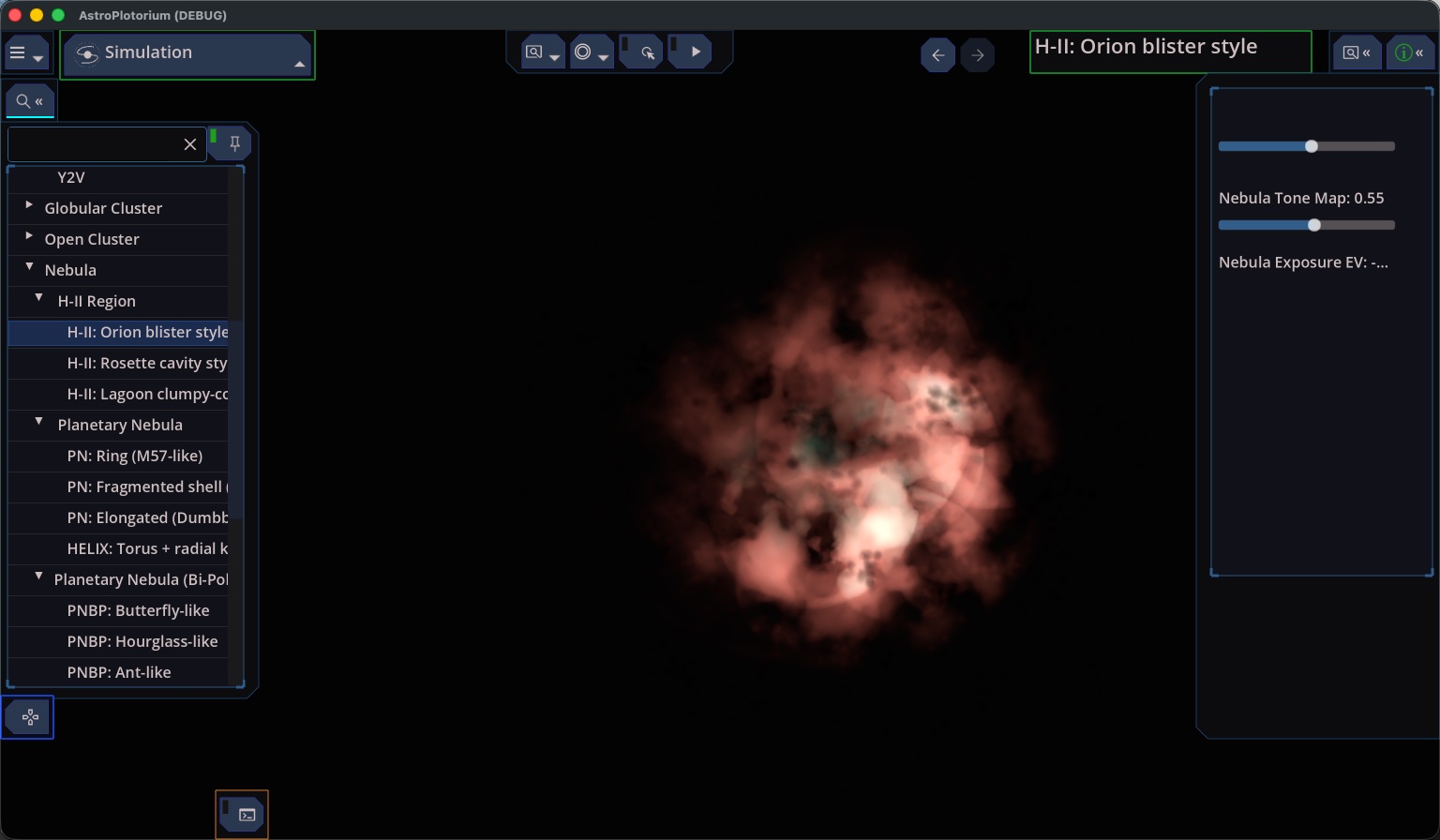
The nebula list is grouped by physical type, with a few familiar silhouettes as teaching shapes:
- H II regions, including blister, cavity, and clumpy styles.
- Planetary nebulae: ring, fragmented shell, elongated, bipolar (butterfly, hourglass, ant), and a Helix-like torus.
- Supernova remnants: filled (Crab-like), shell (Veil-like), and clumpy (Cas A-like).
- Protoplanetary nebula, emission, reflection, dark nebula, flux nebula, and a protoplanetary disk.
Names like “Crab-like” mean the morphology. They are not a claim that the mesh is a reconstruction of that remnant.
Black hole
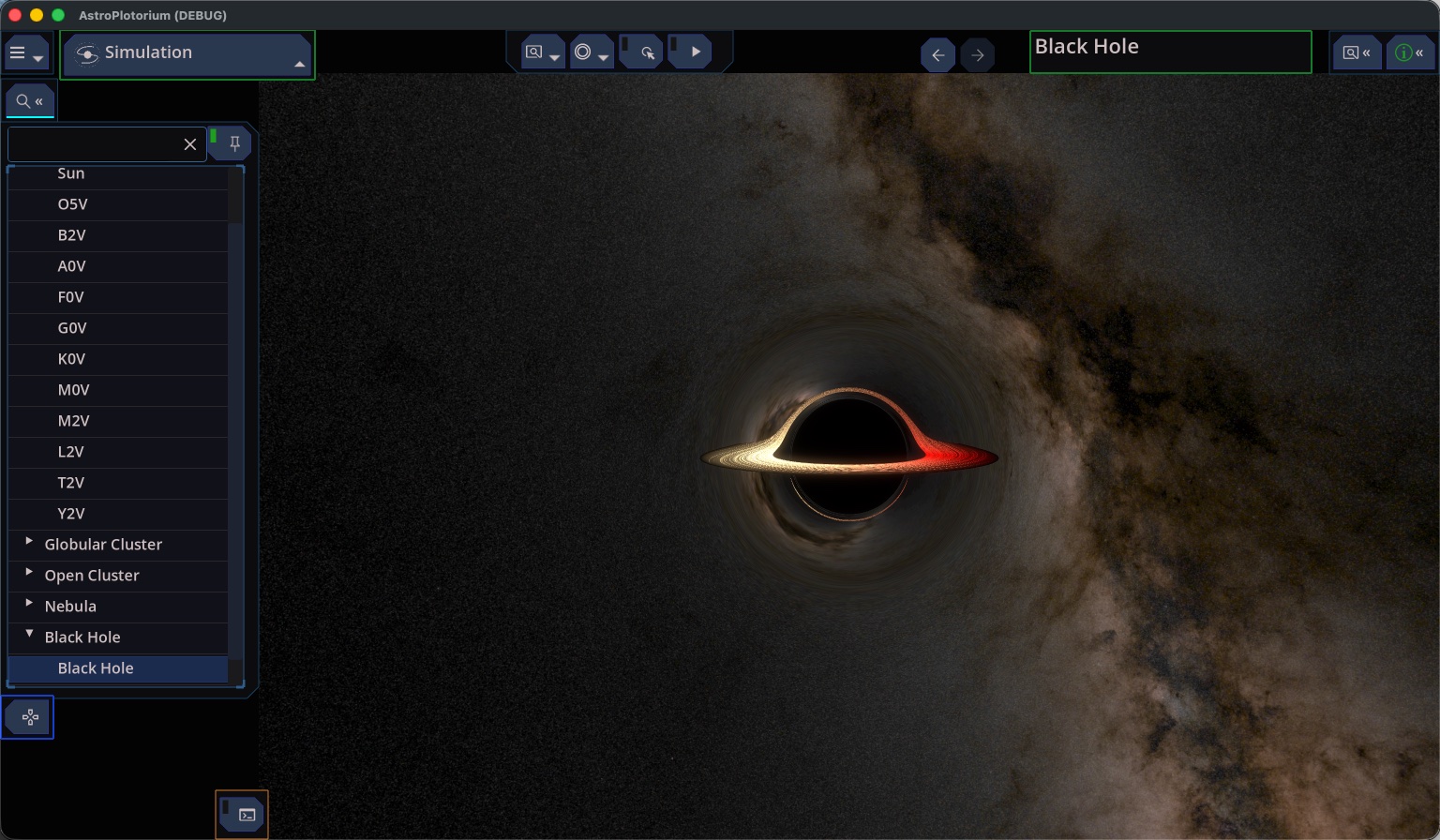
A single black-hole scene shows the lensing-style picture used for teaching. It is an illustration of the optical effect. It is not a simulation of a named source, and it does not include an accretion-disk observation campaign.
While a simulation is open
The navigator lists only simulation entries. The secondary 3D pane hides for a galaxy view so the model can use the window. Switch Main View back to a sky mode or to 3D Universe when you want the catalogs again. Your previous target is still in the history arrows.