AstroPlotorium User Manual
Search
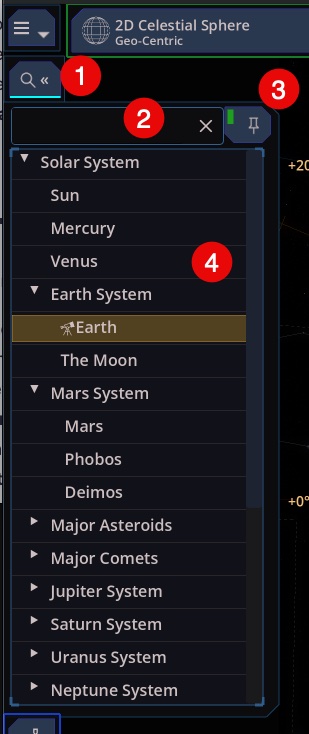
Press Space. The navigator opens if it was closed, and the search box is ready. Type a name or a catalog id and pick a row. Esc leaves the search box.
You can search for a common name (Moon, Vega, Orion), a Bayer name, a planet or moon, a Messier or Caldwell id, and many deep-sky names. If several places share a name, pick the row that shows the country or the catalog id you meant.
- (1) Show/Hide the navigator panel
- (2) search text box
- (3) The pin at the top of the navigator keeps the list open after you select an object. Unpin it and the list closes when you pick a target, which leaves more of the sky visible.
- (4) The Navigator panel
Navigator in the sky views (2D Views)
These lists appear in 2D Celestial Sphere, 2D Planetarium, Ephemeris, 2D Planisphere, 2D Solar System, and 3D Orbit:
- Solar System. Sun, planets, major moons, a short list of asteroids and comets, and dwarf planets.
- Nearby Stars. Bright nearby stars with distance and spectral type.
- Bright Stars. Grouped by magnitude.
- Asterisms. Named figures such as the Big Dipper. Each row has an eye to show or hide that one figure. View All and Hide All set the whole list.
- Constellations. The 88 IAU constellations, plus View All, Hide All, and Zodiac. The eye on a row shows or hides that constellation’s figure without leaving the list.
- Messier, Caldwell, and Deep Space Objects. Deep-sky catalogs. The deep-sky list keeps the brighter and the named objects.
Navigator in 3D Universe
The sky lists above are replaced by space lists:
- Local Celestial Sphere and Current Location.
- 3D Solar System. Inner and outer planets, each as a body, an orbit, or a whole system. Major moons. Major asteroids and comets. Minor planets by a broad type list. Dwarf planets. The whole solar system, or the inner system only.
- Solar System Beyond. Kuiper belt, scattered disc, heliopause, Hills cloud, and the inner and outer Oort cloud. These are region models, not a plot of every known object.
- Nearby Stars Chart 3D. Shells from 5 light-years out to 10,000 light-years, including a few shells limited to stars larger than 1.2 solar radii.
- Open Clusters in 3D. A selected set of clusters drawn with member stars.
- Milky Way Galaxy. The galaxy alone, with Messier objects, with globular clusters, or with stellar streams.
Bright stars and the nearby-star name list stay available so you can still jump to a star.
Navigator in Simulation
Only the simulation catalog is listed: globular-cluster classes, open-cluster classes, nebula types, a black hole, and galaxy Hubble types. See Simulations.